Finding the best Cookware set to buy is rarely about picking the most expensive box on the shelf. For many buyers, the real question is whether the set can perform well in daily cooking, stay presentable after repeated use, and match the sales needs of their market. A good cookware set should feel complete, practical, and easy to position, whether it is sold through retail, e-commerce, wholesale channels, or project supply.
That is why stainless steel remains one of the most dependable choices in the cookware business. It has a clean look, broad market acceptance, and a longer service life than many low-cost alternatives. For importers and private label buyers, it also offers a balanced path between product value and price control. A well-designed stainless steel set is easier to standardize, easier to customize, and easier to explain to end customers.
The best cookware set is not simply the one with the highest piece count. It is the set that solves everyday cooking needs without creating extra trouble in use or after-sales service. Buyers usually look at a few practical points before making a sourcing decision. They care about heating performance, compatibility with different cooktops, handle safety, cleaning convenience, and whether the overall set looks premium enough for the target market.
A cookware set also needs to make commercial sense. Many buyers have faced the same pain points before. Some sets look attractive in photos but feel too light in hand. Some heat unevenly and create hot spots. Some lids fit poorly. Others do not support induction, which limits the markets they can enter. In OEM and ODM projects, these details matter even more because they directly affect repeat orders, product reviews, and brand trust.
Stainless steel cookware continues to stand out because it fits both household use and commercial selling logic. It is durable, easy to maintain, and suitable for a wide range of cooking styles. It also gives a more professional kitchen image than many low-end coated options. For buyers building a long-term product line, stainless steel is often easier to scale because the category has stable demand and broad consumer recognition.
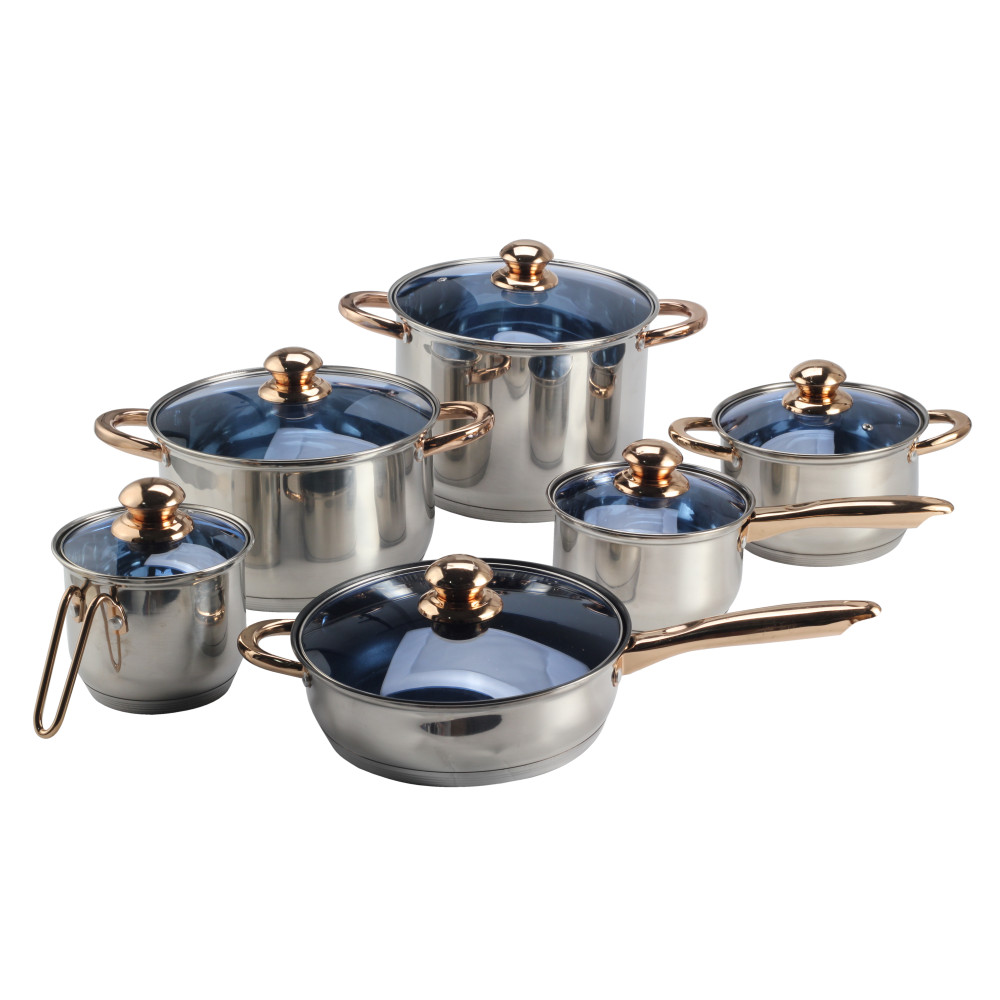
Our product connects well with this buying logic. The 12-piece set uses 18/8 stainless steel construction with an aluminum disc bottom for more even and faster heat distribution, which helps reduce the hot spot problem that often appears in entry-level cookware. It is also suitable for induction, gas, electric, glass, ceramic, and halogen cooktops, which makes it easier for distributors to serve different regional markets with one product line. The cookware is oven safe up to 500 degrees Fahrenheit, while the lids are safe up to 350 degrees Fahrenheit, giving buyers a more versatile product story for retail or bulk order programs.
A cookware set becomes easier to sell when the configuration feels complete. This 12-piece Stainless Steel Cookware Set covers common kitchen needs with saucepans, casseroles, and a frypan, so it is easier for retailers and solution providers to present it as a ready-to-use kitchen package rather than a loose product combination. For many buyers, this matters because complete sets usually have clearer value perception and better merchandising potential.
Another advantage is flexibility in market positioning. The body material can be offered in SS304 or SS201, which gives buyers room to build different price ranges for different markets. Some customers focus on higher corrosion resistance and a stronger premium image. Others need tighter cost control for volume distribution. The available finish options, including satin polishing, mirror polishing, and honeycomb fire textured pattern, also support different visual directions, from classic household retail to modern gift-ready presentation. This kind of flexibility is important for OEM and ODM cooperation because market demand is rarely the same across all countries and channels.
When buyers search for the best cookware set to buy, they are often trying to avoid hidden risks, not just find a beautiful product. One common problem is mismatch between appearance and actual performance. A shiny surface may attract attention, but if the base structure is weak, heat distribution will disappoint users. Another problem is incomplete compatibility. If a cookware set cannot work on induction, many buyers immediately lose access to part of their customer base.
There is also the issue of usability. Handles that feel unstable, lids without proper venting, and cookware that is difficult to stack can all create friction in real use. Those details affect reviews, return rates, and reorder confidence. Our product addresses these practical concerns with tempered glass lids that include steam vents, riveted stainless steel handles for a secure grip, and a flat base structure for better stability on cooktops and easier storage. The reflective finish inside and outside also helps support easier cleaning and a cleaner shelf presentation. Dishwasher-safe construction adds another commercial benefit because convenience has become a key selling point in many markets.
A cookware set may look right on paper, but supplier capability often decides whether the project runs smoothly. This is especially true for project buyers, distributors, and wholesalers who need stable quality across repeated shipments. Delays, inconsistent finishing, and weak packaging control can damage the value of even a good design.
That is why many professional buyers care about more than product photos. They want a supplier who can support OEM development, ODM adjustment, material selection, finish changes, and market-specific packaging. In cookware sourcing, this support is often what separates a short-term transaction from a long-term account. A supplier should understand not only manufacturing, but also how a cookware set will be sold, displayed, and compared in the buyer’s market.
For buyers who want to build their own line, a stainless steel cookware set like this offers a practical base for customization. Material options, finish directions, and product presentation can all support different branding strategies, from mass retail to commercial-grade collections. That makes the set easier to adapt for private label, wholesale distribution, and container-based sourcing plans.
The best cookware set to buy depends on what your market values most. If your customers want low maintenance, a clean metallic look, and broad cooktop compatibility, stainless steel is a strong candidate. If your business needs a product that can be upgraded or adjusted through OEM or ODM service, this type of set gives more room to build a differentiated offer. If you need a balanced product for volume sales, gift promotions, or long-term catalog supply, a complete 12-piece set often gives better selling logic than single items.
Instead of asking which cookware set is best in general, it is more useful to ask which set gives your customers the right mix of durability, versatility, and value. That is where a well-structured stainless steel set performs strongly. It supports everyday use, works across multiple heating methods, and gives buyers more room to shape the final market offer.
So, what is the best cookware set to buy? In practical terms, it is the set that combines reliable cooking performance, a complete and useful configuration, broad cooktop compatibility, and enough customization potential to fit your business model. A stainless steel cookware set checks those boxes more naturally than many trend-driven alternatives, and a 12-piece configuration gives buyers a product that is easier to position and sell.
If you are comparing cookware sets for your next product line, wholesale program, or OEM project, our team can help you evaluate the right material, finish, and product configuration for your market. Share your target channel, price range, or customization needs, and we will give you a clear recommendation that makes sourcing easier and more efficient.
Previous: How To Cook Salmon in Fry Pan?
Next: Are Fry Pans Recyclable?